Showing posts with label drugs. Show all posts

Sunday, May 10, 2015

"Nano" drug that prevents kidney toxicity

     The main problem of drugs taken orally is that their distribution can not be specific, that is, it flows through the system of the body through the bloodstream. Once a drug passes from the stomach into the intestines, it goes to the liver and then to the rest of the body through the bloodstream. This causes toxicity to the kidneys when ingested because the drugs slow down the kidney function, causing high levels of substances in the blood, that should be eliminated by the kidneys. To prevent kidney toxicity a "nano" drug that prevents the drug from reaching the kidneys was created.

     Researchers at the Complutense University of Madrid with other scientists have designed a "nano" drug to prevent kidney toxicity. This is possible because when ingested  it accumulates in the spleen, liver and lung. One of the authors of this research, Dolores R. Serrano, indicates that it is ideal to get the greatest possible amount of drug to the "target" organs to reduce this way the amount in places where it produce toxicity. The creation of the "nano" drug was achieved using nanoparticles GCPQ (˂250 nanometers). There are incorporated antifungal drug amphotericin B to these nanoparticles, which are used to treat certain conditions intravenously, being that orally it is toxic to other organs.

     An important advantage of this "nano" drug is preventing hospitalization and adverse effects caused by administering a drug intravenously. This is a very positive aspect, as there are patients who can not stand needles, just like hospitalization is also of little liking. This "nano" drug can be administered with any drug without affecting the kidneys, which is excellent news, because the kidneys have an important function in our body: eliminates toxic agents and recover the nutrients our body needs to regulate internal fluids.

Credits:
Image: 

Friday, May 1, 2015

Drugs with the ability to regenerate neurons to reverse the damage of multiple sclerosis


What is multiple sclerosis?


Main  symptoms of Multiple Sclerosis


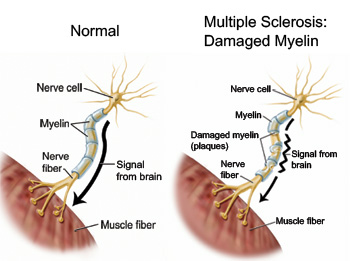
Normal nerve vs a damaged nerve by
Multiple Sclerosis
     It is a disease caused by a damage to the myelin sheath, which is a protective layer around the neurons of the brain and spinal cord. The damage of the sheath causes nerve impulses diminish or stop, causing loss of balance, muscle spasms, weakness, among other symptoms. This disease mainly affects women between 20 and 40 years old, but can be diagnosed at any age. The sheath is damaged when the body's own immune cells attack the nervous system, which means, cells attack themselves by treating natural antigens produced by the body as if they were strangers. 


Signal from brain in a normal neuron vs a damaged
myelin signal
Several United States institutions conducted research on 727 drugs to find the effect for the treatment of multiple sclerosis. They discovered that clobetasol and miconazole, which are used to treat athlete's foot and eczema, has the ability to regenerate damaged brain cells for multiple sclerosis in mice. Previously, they knew there existed stem cells in the nervous system that repair the damage caused by this disease. However, they did not know how to guide them. Paul Tesar, one of the main authors of the study, said that his focus was to find a drug that catalyze the body's own stem, thereby replacing damaged cells by multiple sclerosis cells. 


      With this study, coauthor Miller says that this finding represents a paradigm shift in the treatment of patients with multiple sclerosis. It is expected from the patients to be checked through clinical trials. For now we have tested the effect of drugs on human stem cells and it has been seen a similar response in mice.
   It is unfortunate that there are not known definite causes for this disease, but its being said to be likely that those who have a family history of multiple sclerosis, or live somewhere where the disease is more common, are more prone to suffer from it. These drugs are expected to open their doors for the cure of multiple sclerosis, as currently there are only treatments that slow the progression of the disease.


Credits:
Images from:


Friday, April 10, 2015

Drug treatment to reduce obesity

     Researchers at the National Cancer Research Centre (CNIO) have shown that partial pharmacological inhibition of PI3K enzyme reduces body weight and physiological manifestations of metabolic syndrome, particulary in diabetes and hepatic steatosis (fatty liver). This experiment was conducted with obese mice and monkeys, which showed no side effects or toxicity. The PI3K enzyme is responsible for achieving balance in the production of cellular and biochemical components of cell nutrients spending. The enzime favors and induces cell division and growth and ultimately can  cause cancer. That is why many cancer researchers have worked with the intention of finding a drug that inhibits this enzyme to find a treatment for cancer.

     To test the effect of this enzyme the researchers administered small samples of inhibitor  CNIO-PI3ki to obese mice over a period of five months. After two months, the mice had lost 20% of their body mass. Afterwards their weight remained stable, following a high-fat diet. Another effect was the improvement of physiological symptoms and hepatic steatosis. Elena Lopez, from CNIO, explains that steady weight loss is very dangerous in obesity cases, so it is expected to achieve an alteration in the balance between undertaking and spending of nutrient, favoring the spending of energy. 

     If through more research, they are able to find a way to alter the balance of nutrients encouraging spending, it will be of great help to the obesity problem which most of the Americans face. This problem is due to several factors, one being genetic heritage. It is often difficult to work with and achieve a decrease in obesity because the body needs to store nutrients. That is why this treatment would be of great impact, because there are many people who will benefit from it. Furthermore, not only obesity reduces, this will reduce diabetes. This is a disease that just like obesity, affects a large portion of the American population. It is caused when the body can not regulate sugar levels in the blood, which is treated with a strict and rigid diet. There are three types of diabetes: diabetes type I, diabetes type II and gestational diabetes, which have very harmful effects on the health of the individual. Type I diabetes can not be prevented, however, type II diabetes can be prevented or delayed if you have a healthy diet and active lifestyle.
    For the previously mentioned reasons and many others, we hope we can find an efficient treatment for reducing obesity among the population. Like diabetes there are many more diseases that are caused by obesity. Meanwhile we should promote the correct nutrition in the busy lifestyle of people, since  malnutrition has a big effect due to the time factor.


Video retrived from: https://youtu.be/NjpzSDa7Wro

Credits:

Images:
http://i1.wp.com/clinicadenutricionbiodieta.com/wp-content/uploads/2015/03/raton.jpg
http://img.webmd.com/dtmcms/live/webmd/consumer_assets/site_images/article_thumbnails/reference_guide/prescription_weight_loss_drugs_ref_guide/375x321_prescription_weight_loss_drugs_ref_guide.jpg

Sunday, March 29, 2015

Misuse of Antibiotics


     On March 27, 2015 the White House announced a five-year plan. It aims to combating the threat of antibiotic-resistant bacterias. Some of these become resistant to antibiotics, so they want to prevent that bacteria’s from becoming deadly by this action. Saying that there are bacterias that become resistant to certain antibiotics means that these bacterias develop the ability to inhibit the effects of the antibiotic in the body, thus making the drug  inefficient for its intended purpose. When transformed, the bacteria survives the antibiotic, thereby multiplying and causing more damage.


Non-resistant Bacteria vs Drug Resistant Bacteria
     The Centers for Disease Control and Disease Prevention (CDC) estimated that antibiotic-resistant bacterias cause each year in the United States 23,000 deaths and 2 million illnesses. These are very significant figures to start searching so we can combat the threat of these bacterias in the United States and other countries. It has been shown that the misuse of antibiotics causes bacterias to become resistant to them, so it is expected an wherever antibiotics are prescribed unnecessarily.

     "Critics say it would be preferable for the White House to go further, especially in terms of the antibiotics used in animals that are afterwards processed meat for human consumption. The Food and Drug Administration (FDA) has already asked many pharmaceutical companies to eliminate the use of antibiotics for growth promotion in animals, but advocacy groups have asked the agency to also halt other uses of antibiotics in animals , like the prevention of diseases when animals are kept in cramped conditions."

    By prohibiting the antibiotic supplementation to animals, the contagion also slows down in the humans that eat them, for the excessive and inappropriate use of antibiotics causes bacterias to become resistant to it. It is not easy to create an antibiotic to fight bacteria, since any antibiotic has to change once the bacteria becomes resistant. In fact, this new antibiotic will need to be very different from the one initially used.

References:
Pictures:[1]:http://recend.apextech.netdna-cdn.com/images/tn/0/0/1200/596/900/447/2015/03/27/bacteria-reuters-bbc.jpg
[2]: http://www.niaid.nih.gov/SiteCollectionImages/topics/antimicrobialresistance/1whatIsDrugResistance.gif


Friday, March 20, 2015

Multivitamins: Poorly Manufactured


     According to the database Cerner Multum, Inc., multivitamins are a combination of many different vitamins that are normally found in foods and other natural sources. The newspaper “El Nuevo Dia” reported an investigation about the Quality of Vitamin Products in Puerto Rico. It revealed that some multivitamins sold locally are not manufactured properly, which poses a risk to consumer health. Many multivitamins do not comply with federal regulations, neither with clinical studies with high value.

     Investigators found that some of the tested products did not have the vitamins that they said they contained. They did not meet the identity, purity and composition which was indicated on its label. Also they found the presence of metals which are dangerous to the brain and our organs: causing skin irritation, kidney damage, anemia, among others. Another situation was the finding of increased amounts of iron per liter: 13,000mg per liter, when the allowed quantity is only 18 mg per liter. It is expected an amendment by the government of Puerto Rico and the Federal Food and Drug Administration to regulate multivitamins in the same way that prescription drugs are regulated.

      This news is important because it alerts us, as consumers, to choose multivitamins or other specific "over the counter" drugs carefully. As responsible consumers we should research the different drug brands and how to choose the most reliable drugs, whether brand name drugs or generic. It is unfortunate that there is no such strict regulations for this type of medication, so it is up to us consumers to watch what we ingest, because it is our health what is at stake.


If you want to read more about this you can acces online to this notice: http://www.elnuevodia.com/noticias/locales/nota/vitaminasquesonunpeligro-2020176/
                     
Credits:
-Pictures from: http://www.howitworksdaily.com/wp-content/uploads/2010/07/iStock_000008873262Medium.jpghttp://www.oliveronews.com/uploads/2/6/4/4/26440126/5136922_orig.jpg

Saturday, March 14, 2015

Drugs that slow aging

     Day after day, researches are being conduced in finding solutions to social situations and in pursuit of an improved quality of life. On March 9, 2015 the journal Aging Cell revealed a study conducted by the Scripps Research Institute (TSRI), Mayo Clinic and others, which demonstrated in animals the ability to significantly delay aging. This research opens the door for increased life expectancy of human beings.


Image from: http://cdn.business2community.com/wp-content/  uploads/2013/07/Slow-Down-Aging.jpg     Professor Paul Robbins with Professor Laura Niedernhofer awaits the development of a safe treatment with the studied drug that will: alleviate signs of weakness, improve heart function and increase life expectancy. It is expected from the drug components to work effectively against disorders and diseases related to aging, therefore improving the quality of life of people.

     The clinical study was conducted with the combination of two senolytics agents: dasatinib and quercetin. These agents are more efficient together; they kill senile cells, those which stop dividing and increase with age, accelerating the aging process. By killing these cells the lifespan of mice in the experiment increased, so it is expected that the same mechanism will be performed in humans.

     It's amazing how we challenge nature with our progress in trying to have a better quality of life. This study will continue developing in animals until we find a way to handle this cellular mechanism in humans. Who would not like to extend their life a little? ... These "needs" of human beings is why scientific field broadens more and more.


Video retrived from: https://youtu.be/J2GPtZhos5Y

If you want to read more about this research you can access online: